
Karnataka's Chief Minister Siddaramaiah has requested Prime Minister Narendra Modi to take measures to protect Indian citizens in the Middle East due to escalating geopolitical tensions, including initiating evacuation plans and enhancing diplomatic efforts.

Indian benchmark indices, Sensex and Nifty, rallied significantly following a sharp decline in crude oil prices. This decline was triggered by US President Donald Trump's announcement of progress in negotiations with Iran towards a peace agreement, which led to renewed optimism in global markets.

Given all the risks in the world today, including the political instability, economic uncertainty, public health emergence and terrorism, there is not much buffer to absorb a significant change for the worse in the operating environment

India's consumption stocks, which have outperformed the broader market, are now facing significant pressure due to a gradual rise in fuel prices and the potential for higher inflation. Analysts warn that companies may be forced to pass on increased input costs to consumers, potentially hurting demand across both staples and discretionary categories, with a looming threat of deficient monsoon rainfall further exacerbating inflationary concerns.

Indian markets on Dalal Street rallied sharply as easing tensions in the US-Iran conflict and stable oil prices boosted sentiment. Track Nifty50 and BSE Sensex performance and key global triggers.

Indian benchmark indices Sensex and Nifty experienced a significant slump in early trade, driven by a sharp surge in crude oil prices above USD 120 per barrel, weak global market trends, and continued foreign fund outflows.

Indian equity benchmark indices Sensex and Nifty rallied in early trade, driven by reports of a second round of talks between the US and Iran, which are fostering hopes for a resolution to the West Asia conflict, coupled with Brent crude oil prices trading below the USD 100 per barrel mark.

High taxes, high airport costs, poorly developed air navigation and high cost of operations makes investment unappealing.

Indian airports are rapidly becoming a significant growth avenue for the country's retail sector, with brands across various consumer segments actively opening stores to tap into the increasing number of flyers and strong domestic tourism momentum.

Indian benchmark indices, Sensex and Nifty, saw a significant rebound in early trade, driven by a decline in crude oil prices. This drop followed US President Donald Trump's announcement of progress in negotiations with Iran towards an agreement to end the war, leading to a temporary pause in 'Project Freedom' to escort ships through the Strait of Hormuz. Track Nifty 50 and BSE Sensex performance and key global triggers.

Indian benchmark indices, Sensex and Nifty, opened lower on Tuesday, driven by a surge in global crude oil prices and continued outflows by Foreign Institutional Investors (FIIs), reflecting fragile market sentiment influenced by external factors.

Indian stock markets experienced a significant sell-off, with the Sensex tumbling over 1,300 points, driven by escalating crude oil prices due to US-Iran tensions and Prime Minister Narendra Modi's call for austerity measures, which amplified investor concerns about India's economic outlook.
The government has suspended its directive requiring airlines to offer at least 60% of seats on flights without additional charges, following industry concerns about the impact on fares and pricing structures.

The Indian government disclosed that 176 aircraft operated by non-scheduled and general aviation operators lack flight data and cockpit voice recorders, raising safety concerns. The disclosure was made in response to a query in the Rajya Sabha.

Indian equity benchmark indices Sensex and Nifty surged significantly in early trade, mirroring a global market rally and a drop in crude oil prices below USD 100 per barrel, driven by renewed hopes of diplomatic engagement between the US and Iran.
"This is the best time that Indian aviation is seeing and the next six months will be critical. The airlines should monetise this growth without getting into unnecessary capacity addition," said Nikhil Vora, managing director, IDFC-SSKI, a financial services group.
Indian benchmark stock indices, Sensex and Nifty, surged over 1 per cent, driven by optimism surrounding potential US-Iran peace talks and a significant drop in crude oil prices below the USD 100 per barrel mark. This de-escalation in geopolitical concerns and easing inflation pressures provided a substantial boost to investor sentiment.

Indian equities on Dalal Street saw volatility as global market trends and oil price hike impacted investor sentiment. Track Sensex, Nifty50 movement and key market drivers for Apr 23, 2026.
Indian benchmark stock indices, Sensex and Nifty, closed nearly 1 per cent lower following the collapse of US-Iran negotiations, which heightened concerns of a prolonged conflict in West Asia and drove crude oil prices sharply higher.
Indian equity benchmarks, Sensex and Nifty, ended lower after a spectacular rally, with the Sensex tumbling 931 points, as renewed tensions in West Asia, particularly the risk to the ceasefire deal after Iran closed the Strait of Hormuz, dampened investor optimism.

SKYTRAX's annual airport rankings for 2026, based on a global passenger poll, placed four Indian gateways within the top 100. Delhi moved up to 28th and led the India-South Asia region, while Hyderabad climbed to 43rd and earned praise for staff service. Goa and Mumbai improved to 64th and 66th respectively.

24 Indian-flagged vessels with 677 Indian seafarers were currently located west of the Strait of Hormuz, and four vessels with 101 Indian seafarers were stationed east of the strategic waterway.

Indian airlines are now required to offer 60% of seats for free and ensure families sit together, as the government strengthens passenger rights and addresses concerns about high seat selection fees.
Two new airlines -- Al Hind Air and FlyExpress -- are set to take to the skies, with the carriers receiving their no objection certificates from the civil aviation ministry.
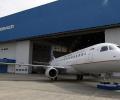
The Indian government is actively promoting manufacturing in the rapidly expanding aerospace sector, with collaborations between Indian and foreign companies leading to the establishment of new facilities.
IndiGo, Air India, and SpiceJet are opposing the government's directive to offer 60% of seats for free selection, arguing it will lead to increased airfares to compensate for lost revenue.

Nath's comments came amid the Congress party's continuous attack on Centre for the recent hike in commercial LPG cylinders and the Aviation Turbine Fuel (ATF).
IndiGo has the lowest pilots-to-aircraft ratio among domestic airlines in India, according to data presented in Parliament. SpiceJet and Akasa Air have the highest ratios. Air India Express employs the most expat pilots.

Flight operations at Pune airport have resumed after a fighter aircraft experienced a technical issue during landing, causing a temporary runway closure and affecting numerous flights.

The RusBeam 2800 is now India's largest electron-beam wire deposition 3D printer operating under vacuum. The machine was custom-built for India and is operated with software developed by Rosatom.

Indian benchmark indices, Sensex and Nifty, closed almost unchanged in a volatile session as investors reacted cautiously to mounting geopolitical headwinds and a significant jump in crude oil prices, with Brent crude surging to USD 94.68 per barrel.
The aviation sector needs $30 billion worth of investment over the next 15 years to keep up with booming passenger and cargo traffic, Secretary Nasim Zaidi said on Friday.

Aviation Turbine Fuel (ATF) prices have more than doubled to a record high, impacting airlines and consumers, while commercial LPG rates also see a significant increase.
India's aviation sector is facing fresh turbulence, with rising fuel costs, the Ministry of Civil Aviation's free-seat directive, and geopolitical disruptions in West Asia clouding near-term earnings visibility.
The deadly plane crash at Mangalore on Saturday, which has left 158 persons dead, is one of the biggest in Indian aviation history. Prior to this, the worst airline crash witnessed in Karnataka was on February 14, 1990, in Bangalore, in which 89 persons were killed. However, there were 50 survivors in that crash.

The Indian banking sector is projected to experience a steady 9-13 per cent industrial credit growth in the first half of 2026, driven by capital expenditure, infrastructure development, and sectoral demand recovery, according to a Ficci-IBA survey.
The scrip is moving northwards since last one month, as Deccan Aviation was considering proposals to infuse additional capital by way of private equity or stake sale.
Indian benchmark indices Sensex and Nifty experienced volatility due to conflicting developments in West Asia, including reports of the Strait of Hormuz closure, which led to a rebound in crude oil prices and heightened investor concerns about supply disruptions and inflation.

Airbus has inaugurated a state-of-the-art technology centre in Bengaluru, India, significantly expanding its strategic presence and supporting its 'Make in India' mission.

Under the proposal, if a foreign carrier does not operate flights to a particular Indian airport for 'four consecutive IATA seasons', the regulator may suspend that airport authorisation.
